
By Amy Cockerham
Public Ed Works
CHAPEL HILL (May 22, 2026) – Students at Chapel Hill-Carrboro City Schools are learning science through hands-on experiences after a new state science standard rollout and donations from a local public school foundation.
“They really enjoy it,” Smith Middle School science teacher Tate Little said. “I can see they kind of light up, and they have fun, and they’re talking about it. They’re talking about the data that they get, they’re talking about the results.”
High school student Zaurie H. agreed that the new curriculum has been helpful.
“I think doing science hands-on is a great way to learn,” she said. “It’s a different learning style, because like most times in school they don’t incorporate different learning styles.”
Getting the equipment initially was a challenge because with state public school funding in the bottom of the nation, schools don’t have the budget for new spending.
Like many public schools across the state, Chapel Hill-Carrboro City Schools have faced declining enrollment as well.
Luckily, Chapel Hill-Carrboro Public School Foundation stepped in and brought students microscopes, sensors and other equipment donated from UNC, labs at Duke and The National Institute of Environmental Health and Sciences.
“I think we face a lot of challenges in local education funds, our local education foundations are going to play a more significant role in the success of our schools in the future,” Chapel Hill-Carrboro Public School Foundation Executive Director Madeline Blobe said.
“It’s really to their benefit, and strong schools are really important to a vibrant community. So it makes sense for local businesses to invest in their schools.”
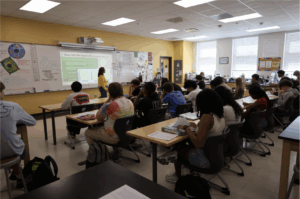
Students listen intently in Chapel Hill High School Biology class as they prepare for the lab of the day.
“We’re really fortunate here at Chapel Hill High School and with the Public School Foundation to provide the resources, the technology and the lab equipment because the lab equipment is expensive,” High School Biology teacher Kadie Ondrus said. “It also gives our students an advantage to be able to interact with that technology that they might come in contact with later down the line in a future career.
Since starting the new curriculum, teachers have seen test scores improve.
“The results are the best part of all,” said Valerie Sellars, Secondary Science Coach with Chapel Hill-Carrboro City Schools. “That success is every single student group… met or exceeded state expectations in both tested subjects of eighth grade science and biology.”
That’s proof that investing in our schools is worth it.
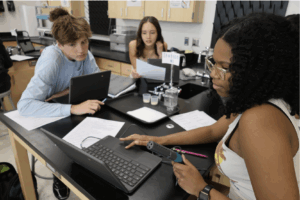
Chapel Hill High School Biology students learn about anaerobic respiration using probe sensors to detect CO2 levels.
“Being here in the classroom today reminds me that these young people are our future,” Blobe said. “North Carolina is a wonderful place to live and work, but we have to prepare them. We have to invest in our schools, invest in these young people and invest in our future.”
Leave a Reply